Loading dashboard
Preparing your dashboard…
Loading dashboard
Preparing your dashboard…
U.S. Navy Military Retiree
Bio
US Navy retired Chief Petty Officer (E-7) with service from August 1961 to May 1986. Duty stations include USS Vancouver (LPD-2), USS Worden (DLG-18), USS Knox (FF-1052) along with various tours in Japan (Okinawa, Sasebo, Totsuka and Yokosuka) as well as stateside locations at Key West, Florida and Fallon, Nevada) along with stints at various training commands.
Current City
Montgomery , Alabama
Birthday
May 20, 1944
Branch
U.S. Navy
Service Years
1961 - 1986
USN
U.S. Navy
The USN stands for the United States Navy, which is the naval warfare branch of the United States Armed Forces. It is responsible for conducting operations at sea, on land, and in the air to protect and defend the United States and its interests. The USN operates a vast fleet of ships, submarines, and aircraft to carry out its missions around the world. It plays a crucial role in maintaining national security and projecting American power globally.
COMSERVGRU-3
U.S. Navy
**Combat Service Group Three (COMSERVGRU-3)** was a United States Navy logistics and support command, established to provide essential supply, repair, and administrative support to fleet units operating in the Pacific Ocean. Formed during the post-World War II era, COMSERVGRU-3 played a significant role during the Korean and Vietnam Wars, ensuring that combat ships received fuel, ammunition, and provisions while at sea. The unit was headquartered at Pearl Harbor, Hawaii, and managed a variety of auxiliary vessels, including oilers, tenders, and supply ships. Over the decades, COMSERVGRU-3 contributed to the Navy’s sustained operational readiness before being reorganized as part of modern fleet support structures.
NAS Key West FL
U.S. Navy
Naval Air Station (NAS) Key West, Florida, has a distinguished military history dating back to the early 19th century when the U.S. Navy established a presence in the area to combat piracy in the Caribbean. During World War II, NAS Key West played a critical role as an anti-submarine warfare training base, protecting Allied shipping lanes from German U-boat attacks. Throughout the Cold War, the station became a vital training site for naval aviation, taking advantage of its year-round good weather and proximity to open sea airspace. Today, NAS Key West remains an important installation, supporting air-to-air combat training, fleet readiness, and joint operations with allied forces.
USS Worden (CG-18)
U.S. Navy
USS Worden (CG-18) was a Leahy-class guided missile cruiser commissioned into the United States Navy in 1963. Named after Admiral John Lorimer Worden, she played a key role during the Vietnam War, providing naval gunfire support and serving on Yankee Station. Throughout the Cold War, Worden participated in numerous exercises and deployments in the Pacific and Indian Oceans, showcasing American naval power. After over two decades of service, she was decommissioned in 1993 and later sunk as a target in 2000.
NAS FALLON NV
U.S. Navy
Naval Air Station (NAS) Fallon, located in Fallon, Nevada, was commissioned in 1942 as a pivotal training base during World War II. Over the decades, it evolved into the premier air-to-air and air-to-ground training facility for the U.S. Navy. In 1996, NAS Fallon became home to the Naval Strike and Air Warfare Center (NSAWC), which includes the famed TOPGUN program. Today, NAS Fallon remains a critical site for advanced tactical training, supporting carrier air wings and enhancing naval aviation readiness.
NAVRADSTA T Totsuka
U.S. Navy
NAVRADSTA T Totsuka, or Naval Radio Station Totsuka, was a key United States Navy communications facility located in Totsuka, near Yokohama, Japan. Established in the aftermath of World War II, the station served as a critical relay point for naval communications throughout the Western Pacific region during the Cold War. NAVRADSTA Totsuka played an essential role in supporting U.S. Seventh Fleet operations, intelligence gathering, and maintaining secure lines of communication with other U.S. and allied forces. The station was eventually decommissioned as newer technologies and consolidated facilities rendered its functions obsolete, marking the end of its decades-long contribution to U.S. naval operations in the Pacific.
USS Knox FF1052
U.S. Navy
USS Knox (FF-1052) was the lead ship of the Knox-class frigates in the United States Navy, commissioned on April 12, 1969. Designed primarily for anti-submarine warfare, she served extensively during the Cold War, conducting patrols, exercises, and escort missions in the Atlantic and Pacific Oceans. The vessel participated in numerous NATO operations and goodwill visits, enhancing U.S. naval presence worldwide. After more than two decades of service, USS Knox was decommissioned on February 14, 1992, and later transferred to Taiwan, where she served as ROCS Chi Yang (FFG-932).
USS Vancouver
U.S. Navy
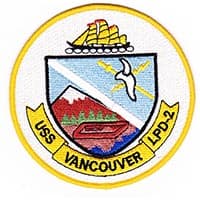
USS Vancouver (LPD-2) was an Austin-class amphibious transport dock commissioned by the United States Navy in 1963. During the Vietnam War, she played a vital role in amphibious operations, troop transport, and support missions, participating in multiple campaigns and earning several battle stars. Throughout the 1970s and 1980s, USS Vancouver continued to serve in the Pacific, taking part in exercises, humanitarian missions, and deployments that reinforced U.S. presence in the region. She was decommissioned in 1992, having served nearly three decades as a key asset in the Navy's amphibious fleet.