
Loading dashboard
Preparing your dashboard…
Loading dashboard
Preparing your dashboard…
U.S. Army Veteran
Branch
U.S. Army
31st ADA
U.S. Army
The 31st Air Defense Artillery (ADA) traces its origins to its constitution in the Regular Army in 1918 as the 31st Artillery (Coast Artillery Corps), serving initially in World War I. Reactivated and reorganized multiple times, the unit was heavily involved in air defense missions during World War II and the Cold War, adapting to emerging technologies and threats. Throughout its history, the 31st ADA has provided critical air and missile defense capabilities in various theaters, including support for NATO and deployments to the Middle East. Today, the brigade remains a key component of the U.S. Army’s air defense mission, equipped with advanced systems such as the Patriot missile.
2:9th Infantry
U.S. Army
The 2nd Battalion, 9th Infantry Regiment (2/9th Infantry), known as "Manchus," is a storied unit of the United States Army with origins dating back to 1855. The battalion earned distinction during the Indian Wars, Philippine–American War, and served with valor in World War II, the Korean War, and the Vietnam War, where it saw heavy combat. In Vietnam, the "Manchus" were renowned for their actions in the Cu Chi and Tay Ninh regions, suffering significant casualties while inflicting heavy losses on enemy forces. In recent decades, 2/9th Infantry has served in both Iraq and Afghanistan as part of the Global War on Terrorism, maintaining its legacy of service and sacrifice.
USARPAC 8TH ARMY
U.S. Army
The United States Army Pacific (USARPAC) and the Eighth Army (8th Army) are key components of the U.S. military presence in the Asia-Pacific region. Eighth Army was activated in 1944 during World War II and played a crucial role in the Pacific theater, later becoming the primary ground force during the Korean War. After the Korean War, the 8th Army remained in South Korea, where it continues to serve as a deterrent and support for the Republic of Korea. USARPAC, headquartered in Hawaii, oversees Army forces in the Pacific, providing strategic leadership and operational support, with the Eighth Army as one of its major subordinate commands.
HHB, 3-2 ADA Battalion
U.S. Army
Headquarters and Headquarters Battery (HHB), 3rd Battalion, 2nd Air Defense Artillery Regiment (3-2 ADA) has a distinguished lineage tracing back to the early 20th century. Originally constituted in 1907 as part of the Coast Artillery Corps, the unit has participated in numerous campaigns, including World War II and the Gulf War, evolving with advances in air defense technology. As part of the 31st Air Defense Artillery Brigade, HHB, 3-2 ADA provides critical command, control, and administrative support to enable the battalion’s Patriot missile operations. Today, the unit remains forward-deployed, maintaining readiness to defend against aerial threats and support U.S. and allied forces worldwide.
HHC SETAF
U.S. Air Force
Headquarters and Headquarters Company, Southern European Task Force (HHC SETAF) was activated in 1955 in Italy as part of the United States Army Europe, tasked with coordinating American military operations in Southern Europe and the Mediterranean region. Originally responsible for logistical support and regional defense, HHC SETAF played a significant role during the Cold War, supporting NATO operations and strengthening alliances with Southern European nations. Over the years, the unit adapted to new missions, including peacekeeping, humanitarian assistance, and crisis response operations in Africa and the Balkans. Today, HHC SETAF continues to serve as a vital command and control element, supporting U.S. Army Africa and promoting stability in the region.
204th Forward Support
U.S. Army
The 204th Forward Support Company is a unit in the United States Army designed to provide logistical and sustainment support to combat formations, typically within a Brigade Combat Team. Activated in the early 2000s as part of the Army’s modular transformation, the company enhanced operational mobility by supplying fuel, ammunition, maintenance, and medical support directly to frontline units. The 204th has participated in multiple overseas deployments, including operations in Iraq and Afghanistan, where its logistical expertise proved vital in maintaining combat effectiveness. Renowned for its adaptability and commitment, the unit continues to play a crucial role in supporting Army missions both at home and abroad.
B Co, 1:33 Armor
U.S. Army
Bravo Company, 1st Battalion, 33rd Armor Regiment (B Co, 1/33 Armor) has a distinguished history within the United States Army. Activated during World War II, the 33rd Armor Regiment fought with valor in major European campaigns, earning several unit citations for its service. In the decades following the war, B Company served in various theaters, including the Cold War in Europe and peacekeeping missions worldwide. In recent years, B Co, 1/33 Armor participated in Operation Iraqi Freedom, providing armored support and playing a crucial role in combat operations before the regiment was reorganized under the Army’s modular transformation.
12th USAFAD
U.S. Air Force
The 12th United States Army Field Artillery Detachment (12th USAFAD) was a specialized unit of the U.S. Army stationed in West Germany during the Cold War. Tasked with the custodial responsibility for nuclear warheads, the 12th USAFAD operated in close cooperation with NATO allies, notably supporting Belgian artillery units equipped with Honest John and later Lance missiles. The detachment played a crucial role in the NATO nuclear sharing agreement, ensuring operational readiness and security of U.S. nuclear assets deployed in Europe. The unit was deactivated in the early 1990s following arms reduction agreements and the end of the Cold War.
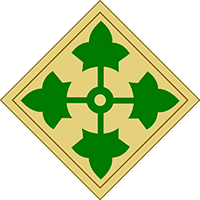
4th Infantry Division
U.S. Army
The 4th Infantry Division is a division of the United States Army that is based at Fort Carson, Colorado. It is known for its role in World War II, where it played a key role in the D-Day invasion of Normandy. The division has also served in the Vietnam War, Operation Iraqi Freedom, and Operation Enduring Freedom in Afghanistan. The 4th Infantry Division is currently a versatile and adaptable unit that trains to deploy rapidly and conduct combat operations in a variety of environments.
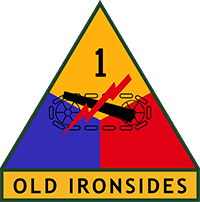
1st Armored Division
U.S. Army
The 1st Armored Division is a division of the United States Army, based at Fort Bliss, Texas. It is a combined arms division with a proud history of serving in World War II, the Gulf War, and multiple tours in Iraq and Afghanistan. The division's primary mission is to provide prompt, sustained, combined arms capability to the US Army in a variety of operational environments. It is known for its distinctive insignia, the "Old Ironsides," and for its motto, "Iron Soldiers."
101st Forward Support Battalion
U.S. Army
The 101st Forward Support Battalion (FSB) was an integral logistical unit within the 1st Infantry Division of the United States Army. Activated in 1987, the battalion provided critical supply, maintenance, and medical support to maneuver brigades, enhancing the combat effectiveness of division operations. The 101st FSB deployed in support of major operations, including Operation Desert Storm and Operation Iraqi Freedom, ensuring seamless sustainment during both combat and stability missions. In the mid-2000s, as part of Army transformation initiatives, the battalion was inactivated and its functions restructured into modular Brigade Support Battalions to better support contemporary combat teams.
Air Defense Artillery
U.S. Army
The Air Defense Artillery is a branch of the United States Army responsible for protecting ground forces and critical assets from enemy aircraft and missiles. They are trained to operate and maintain a variety of weapon systems such as surface-to-air missiles, anti-aircraft guns, and radar systems. The Air Defense Artillery conducts continuous surveillance of the airspace, detects incoming threats, and engages hostile targets to neutralize the threat. This branch plays a vital role in ensuring air superiority and protecting ground forces during combat operations.